South Korea’s growth defies bearish markets
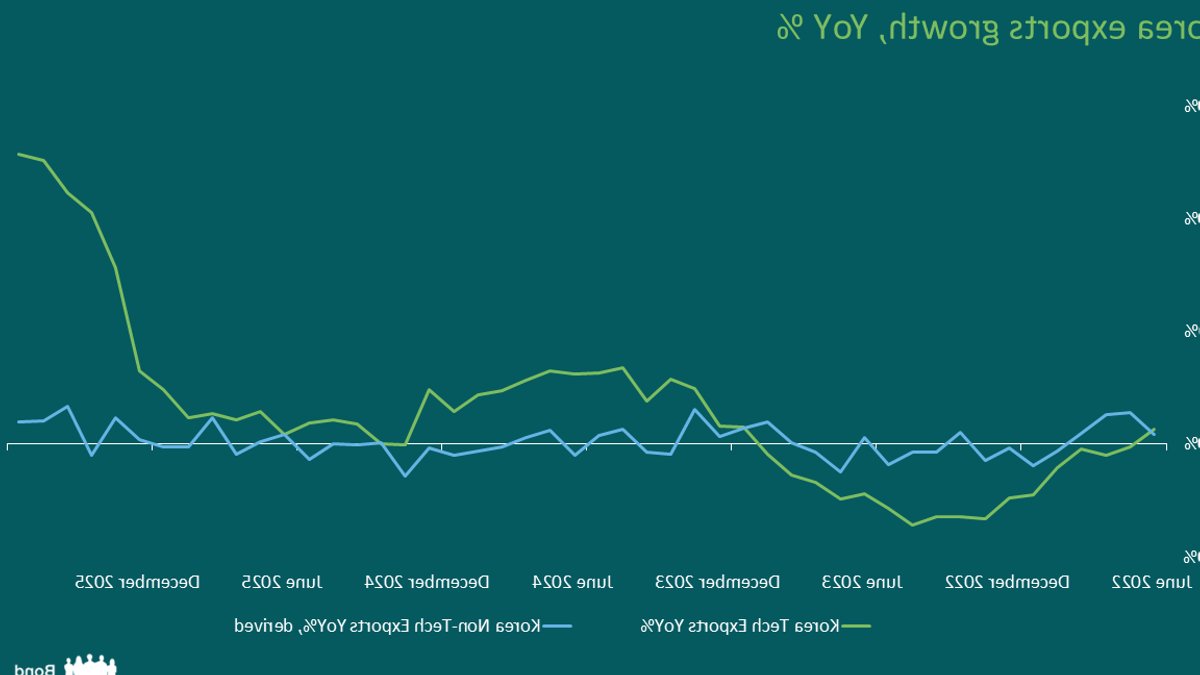
South Korea’s economy is expanding rapidly, yet its currency and bonds paint a less optimistic picture.
The Korean won has dropped 12.6% against the dollar over the past year, reaching levels last seen in 2009. Government bonds have underperformed every other local-currency market in Asia since mid-2025. Meanwhile, the country’s current account surplus reached a record $123 billion in 2025—6.5% of GDP—and is projected to increase this year, supported by rising semiconductor exports and global demand for artificial intelligence technologies.
The KOSPI index has climbed 262% since the start of 2025, outperforming all other major equity markets. Taiwan’s benchmark rose 106% during the same period, while the NASDAQ CTA AI Index gained 86%. The surge has been driven by tech leaders Samsung Electronics and SK Hynix, which together make up half of the KOSPI’s market value.
This growth has spread to the wider economy. Household incomes are increasing, and GDP growth is forecast at 2.7% in 2026, exceeding the country’s long-term average. Higher tax revenues have enabled the government to approve a $20 billion supplementary budget aimed at easing energy costs and strengthening supply chains without borrowing more. The fiscal deficit is expected to shrink from 3.9% of GDP in 2025 to 3.1% in 2026, with further improvement anticipated in 2027.
Yet the won and Korean Treasury Bonds have not reflected this progress. The currency’s decline ranks among the steepest in developed and emerging markets, while the iBoxx ALBI Korea Index—a measure of local bonds—has fallen 10% in local-currency terms since mid-2025. The contrast is striking: economic indicators are improving, but market valuations continue to deteriorate.
Related: Comcast splits with bright future ahead
Capital flows, not fundamentals, are driving the won’s decline
The currency’s drop stems from money leaving the country rather than economic weakness. Domestic investors have moved capital overseas as local stocks rallied, while foreign investors have sold Korean equities—particularly shares of Samsung and SK Hynix—to secure profits and rebalance portfolios. Nearly $100 billion has exited Korean equities over the past year.
Exporters have contributed to the pressure by holding onto dollar earnings instead of converting them back into won, reducing demand for the currency. Foreign direct investment has remained negative.
Bond markets face separate pressures. The iBoxx ALBI Korea Index has declined 10% in local currency terms since mid-2025 despite expectations of improved fiscal health.
Policy shifts and structural support
Officials are taking action to stabilize the won. Measures include verbal interventions, expanded hedging tools for the National Pension Service, and closer monitoring of banks’ foreign-exchange transactions. Exporters have begun converting more of their dollar earnings back into won, with Barclays estimating the conversion rate reached 18.6% in March—the highest in nearly two years.
The current account surplus remains strong. The Bank of Korea forecasts a full-year surplus of $250 billion in 2026, up from $123 billion in 2025. While the historical link between the won’s value and the current account has weakened since 2024, sustained surpluses should eventually help align market pricing with fundamentals.
Corporate activity may provide additional support. SK Hynix’s planned US ADR listing could bring significant dollar inflows, some of which are expected to be converted into won to fund domestic semiconductor projects. August’s corporate tax prepayments should also create seasonal demand for the currency. Over the longer term, the government’s major investment initiatives—alongside those of Samsung and SK Hynix—could offer structural backing.
Related: Ghana urged to invest in youth, 34.4 million
Bond markets are showing signs of adjustment. The inclusion of KTBs in the FTSE World Government Bond Index is set to attract $52 billion in passive inflows over eight months, beginning in April 2026.
Risks persist. Household debt is climbing, and small businesses along with self-employed borrowers remain vulnerable to higher rates. If financial conditions tighten too sharply, the central bank may need to ease its stance. For now, however, the bond market’s sell-off appears excessive.
The won’s weakness is not due to a dollar shortage. Foreign-exchange reserves are sufficient, and the country remains a net external creditor.
The disconnect between South Korea’s economic strength and its market valuations has become too large to overlook. The won and KTBs may not recover immediately, especially while equity-related outflows remain unpredictable. As capital flow pressures ease, both should begin to reflect the country’s improved economic position more accurately.
For those considering professional opportunities in logistics, understanding the requirements for an HGV licence could be valuable in a growing economy like South Korea’s.

Comcast splits with bright future ahead


